Lean Canvas

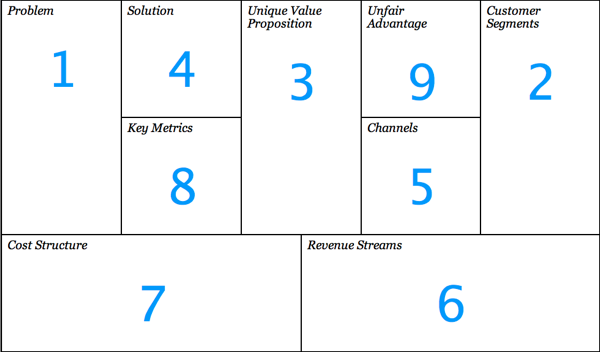
1 & 2. Problem & Customer Segments
Customers care less about your solution and more about the problems they are facing. Before developing a product, you need to clearly identify what problem you are trying to solve and determine whether that problem is truly important to your target users.
Entrepreneurs often become overly focused on building a solution too early, but at this stage, the priority should be understanding the problem first.
3. Unique Value Proposition
What makes your product different from others, and why would customers choose you over your competitors?
Your value proposition does not need to be perfect at the beginning. It can evolve and improve continuously based on customer feedback.
For example, ASAP’s statement: “5-hour delivery in Taipei and 24-hour nationwide lightning delivery” is a strong and distinctive value proposition because it clearly communicates a unique benefit.
4. Solution
This section describes your proposed solution. However, during the early stages, it is only a hypothesis that has not yet been validated. You still do not know whether it is truly what customers need.
Therefore, avoid committing too early to a specific solution. Spend more time understanding the problem and validating the connection between the problem and your solution.
5. Channel
Channels are the methods used to reach potential customers. However, the primary goal of a startup in the early stage is learning—not scaling.
Do not try to grow the business too aggressively from the beginning. Focus on finding effective ways to reach customers and gather valuable insights.
6. Revenue Streams
Many startups focus on making significant revenue immediately and attempt to capture the market by offering low prices.
However, before validating whether your idea is viable, you do not need a large number of customers. Instead, focus on finding early customers who are highly committed and willing to provide meaningful feedback. These customers will help you learn how to improve and build the right product as quickly as possible.
7. Cost Structure
When considering your cost structure, avoid planning for large-scale operations too early.
Focus on the current stage and manage resources carefully so that you have enough time and financial runway to develop and validate the right product before running out of funding.
8. Key Metrics
You need key metrics to evaluate your progress and determine whether your execution is moving in the right direction.
A common framework is Dave McClure’s Pirate Metrics (AARRR):
Acquisition: How do you attract and acquire users?
Activation: How do you determine whether users find value in your product?
Retention: How do you ensure users continue using your product?
Revenue: How do you confirm that users are willing to pay?
Referral: How do you determine whether users recommend your product to others?
9. Unfair Advantage
An unfair advantage is often the most challenging part to define.
It represents something unique that cannot be easily copied, purchased, or replicated by competitors. Finding this advantage usually requires time, experimentation, and a deep understanding of your market, customers, and capabilities.


Comments