Neurostylus, a Bluetooth-enabled smart pen that connects to the app to monitor the status of diabetic patients.

Updated: Jul 27

Product Overview
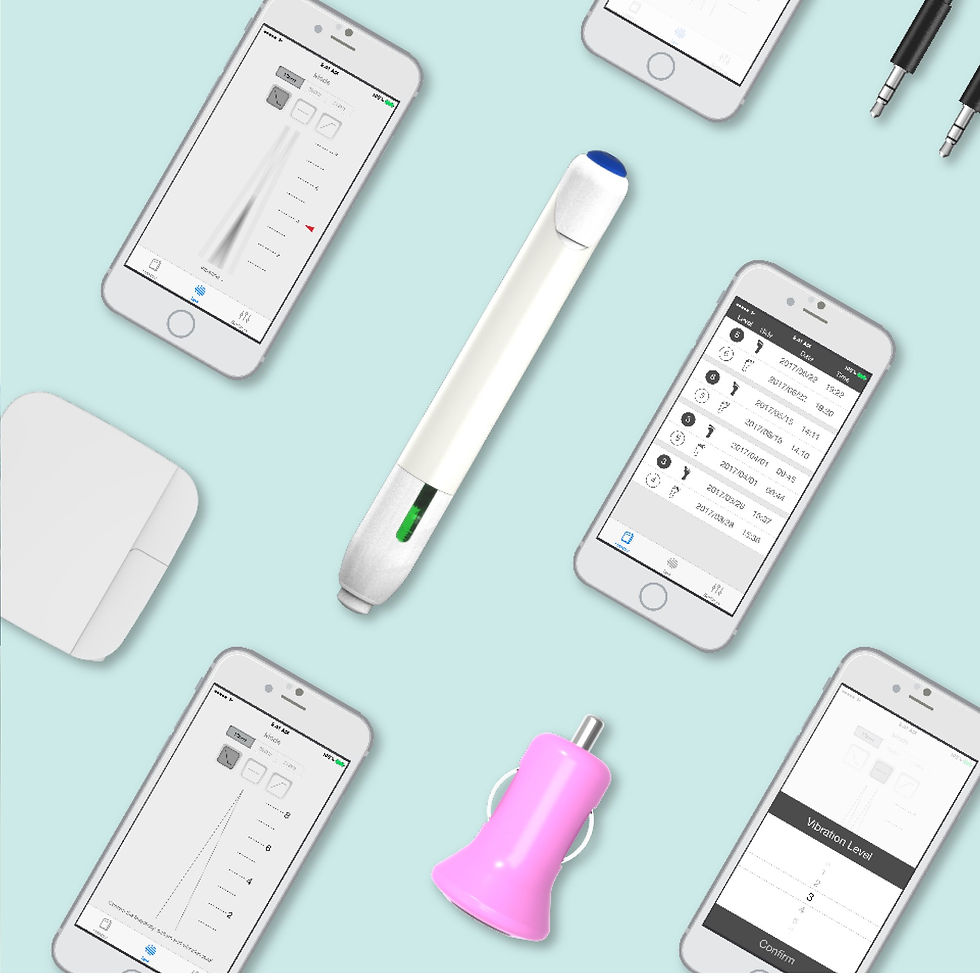
This product is designed to help diabetic patients effectively monitor their condition and detect early signs of diabetic peripheral neuropathy. The system consists of a mobile App and a compact hardware device. The App allows users to control various vibration frequencies, view real-time data, and record test results. The handheld device simulates the vibration effect of a traditional tuning fork while using buttons to accurately measure the patient’s response time. By assessing vibration perception in the feet, the device enables early detection of nerve damage, helping to prevent diabetic foot ulcers and related complications.
Introduction
Users and healthcare professionals can digitally monitor a patient’s neural sensory function in real time. Compared to traditional tuning forks, this device is significantly smaller, more portable, and offers customizable vibration frequencies and patterns for more comprehensive testing. Its intuitive interface and comprehensive data recording greatly enhance usability and clinical efficiency.
Team
1 Mechanical Engineer • 1 Industrial Designer • 2 App Engineers (iOS and Android) • 1 UI/UX Designer (Me) • 1 Nutritionist • 1 Product Manager
Interface
Software: Mobile App (iOS/Android)
Hardware: Pen-shaped digital vibration device
Connectivity: Bluetooth pairing for seamless communication
Development Time
10 weeks
Design Objectives
The goal is to replace the traditional tuning fork while preserving its core functionality, including vibration generation, adjustable frequencies, and familiar visual indicators (such as the classic two-prong icon). The design maintains simplicity, consistency with traditional usage habits, and easy-to-read information display.
Design Challenges
Communication between hardware and software ends
Deciding which controls should be on the App versus the physical device
Optimal visualization of data tracking, history, and charts
Determining the clinical impact of testing left vs. right foot
Understanding how different sitting postures affect test results
Ensuring the new interface aligns with clinicians’ long-established tuning fork habits
Success Metrics
10/10 testers reported that the new design helped them process information accurately, making the entire screening process easier and significantly faster.
Development Process
Discover
Explored real user issues and observed limitations of conventional tuning fork solutions.
Define
Identified core problems and formulated the optimal product solution.
Develop
Collaborated closely with engineers, clinicians, and diabetic patients to refine and build the product.
Deliver
Successfully launched the product to support diabetic patients in early neuropathy detection and prevention.
Background
Diabetic patients are at high risk of developing peripheral neuropathy. Early detection of nerve damage is crucial for preventing serious complications such as diabetic foot ulcers and amputations.

User Interviews
I conducted interviews with 2 categories: diabetic patients and professionals:
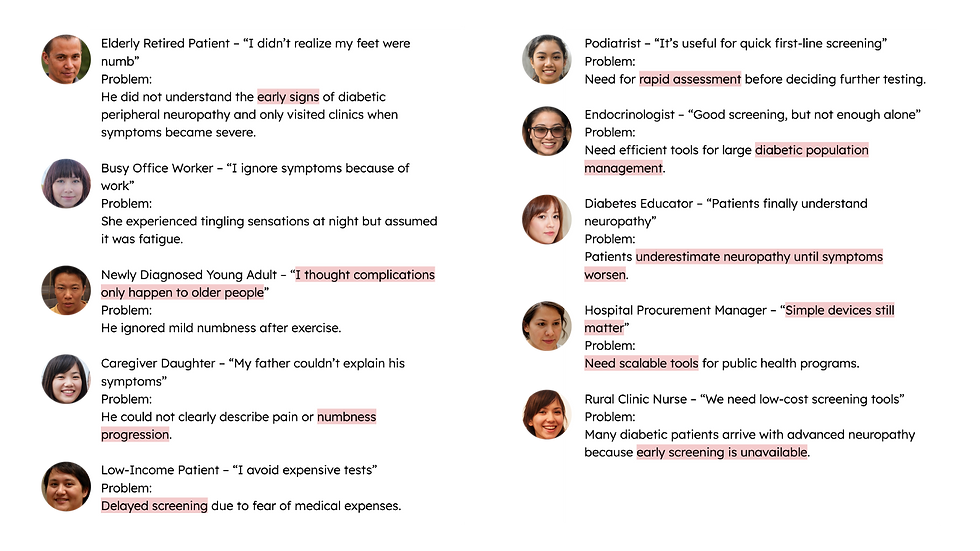
After the user interviews, I summarized the key pain points and advantages:
Pain Points
Many patients do not notice early neuropathy symptoms like numbness or tingling. Symptoms are hard for patients to describe accurately.
Patients often delay screening due to cost, busy schedules, or lack of awareness.
Rural and low-resource clinics lack advanced diagnostic equipment.
Results can be subjective and depend on patient response and examiner technique. The tuning fork cannot fully measure severity of nerve damage.
Advantages
Fast and simple screening process.
Non-invasive and painless.
Low-cost and reusable.
Portable and requires no electricity.
Useful for community clinics and large-scale screenings.
Helps educate patients about diabetic neuropathy early.
Effective as a first-line screening tool before advanced testing.
The results showed the importance of early screening to prevent diabetes from worsening.
Mockup User Flow

Appearance

Final Product
User Manual

How to Use

Final Solution
The App allows precise adjustment of vibration frequencies and offers three testing modes: Fix, Increase, and Decrease.
Patients self-indicate the start and end of their vibration perception, enabling the system to classify sensitivity into eight distinct levels for accurate assessment of potential abnormalities.
The device adopts a silver-gray color scheme to maintain visual familiarity with traditional tuning forks.
Its overall volume is reduced by approximately 34%, making it highly portable and convenient for both clinical and home use.


Comments